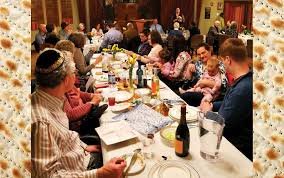
REFLECTIONS ON A SEDER 5786
I’m an amcha Jew, a Jew whose Judaism primarily rests on this incredibly deep sense that these are my people. Even when I completely disagree with them. I don’t believe in Rabbinic Judaism, which has been the primary force in Judaism since the destruction of the second Temple. I’m not a Kabbalist, the mystical subset of Rabbinic Judaism. I’m not a Tikkun olam or social justice Jew, though I certainly believe in social justice and I joked that Pam Bondi got raptured at our community seder and everyone laughed. I’m not an AIPAC Israeli state right or wrong kind of Jew, God forbid. If (when) the state of Israel falls under the weight of its sins, I will not have any kind of crisis of identity, if I am still alive. It would be a terrible tragedy in many ways, but I will still belong to this crazy people called the Jews who will find our way through to our next incarnation.
There’s growing distance between the Jews of Israel and the Jews of the diaspora. An easy stat is that the war with Iran enjoys something like 90% support from Israeli Jews, while my friends and I shake our heads, thinking there is no way that this is going to end well—for anybody. Within the American Jewish community, Israel has gone from being a unifying force to a highly divisive one. The era of American Jews living off of some kind of reflected glory from the little state that could ended in Gaza and will be buried in Lebanon and Iran and violence against the Palestinians in the West Bank.
And what will replace it? That’s the question facing American Jews, even if some of us stick our heads in the sand and pretend it doesn’t exist. I’m not sure that’s quite the right question. Maybe there will be a smorgasboard of replacements. I can tell you some things that won’t replace it. We aren’t going back to an orthodox practice, which is what Peter Beinart’s personal answer seems to be. Some of us already have and some will, but most of us won’t. We aren’t going to become earth based Jews in different flavors. Some of us already have and some will, but most of us won’t. We aren’t going to become social justice Jews, because we’ve already tried that and, on the whole, found it spiritually both not nurturing enough and not unique enough—after all you can work for social justice without being Jewish.
That brings me to the seder. It was a really progressive, social justice oriented seder, emphasizing liberation from pharoah, liberation from enslavement for black folks here in the states. It wasn’t that I disagreed with anything we read; it was certainly more comfortable than ending the Seder with a plea to the divine for retribution against our enemies and this horrid line. “Happy the one who takes and dashes Your little ones against the rock!” (Psalm 137:9).
It wasn’t that I disagreed with any of it. But it was missing something, apart from the deep connection to land that is the wellspring of my spirituality. I want to say it wasn’t Jewish enough, but that’s not quite right. Social justice for all people is certainly a core Jewish value.
But it felt like it missed our peoplehood. Like it missed our long history of suffering in exile, bouncing from country to country, licking the boots of our rulers hoping that they wouldn’t kick us out. It missed the aching pain of knowing that we have become like Pharoah when we watch the state of Israel’s actions towards the Palestinians and the Lebanese. We flex our muscles believing that might makes right—and those are our brothers and sisters who are doing what must be condemned.
Perhaps the seder came from too privileged a place, like we could worry about others (descendants of enslaved backs, LGBTQIA+ etc etc) but didn’t have to worry about ourselves. And we have to worry about ourselves—both that we are vulnerable to the rise of anti semitism on the right and the left, and to our becoming Pharoah in front of our very eyes. It’s a profoundly uncomfortable moment in history where we desperately need the community of the Jewish people. And I was left without any real sense of that the seder emphasized Jewish peoplehood. .