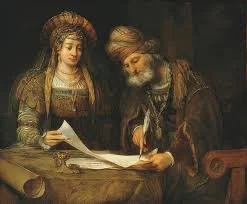
The sacred feminine and the sacred masculine are prominent themes in the story of Purim.
Purim is a myth, it is not history. By myth I mean a story of ancestors, Gods or cultural heroes or heroines that is designed to guide us and utilizes symbols whose totality cannot be captured. I believe Purim is a myth both for the positive reasons that it fits the definition I have just offered and because there’s simply no evidence that any of the events described in Megillat Esther, the scroll of Esther, ever happened. Further, the story doesn’t even make sense as history, because the Persian empire was well known for its general tolerance for minorities as long as they didn’t rebel against the empire. So the idea of a mass pogrom against the Jews would have been out of character for the Persians. This isn’t me saying this, see the essay introducing the Scroll in the JPS Jewish Study Bible by scholar Adele Berlin Ph.D.
Sacred masculine and feminine refer to energies that are present in all of us, male, female, non binary, trans or cis. I generally believe that part of our work in life is to integrate these energies.
The sacred feminine is embodied by both Vashti and Esther. The sacred feminine is always involved when we are discussing archetypal Queens.
Vashti is a certain kind of archetype of a Queen who has had enough of her drunken whoring husband. The story begins with Vashti’s refusal to reveal herself to the drunken party. The text says that she is commanded to appear wearing her royal crown (Megillat Esther 1:11-12)) and the midrash takes that to mean that she is to appear wearing only her crown i.e. naked (Megillah 12B). There are a lot of contemporary Jewish views elevating Vashti for her righteous refusal (e.g. https://rabbisylviarothschild.com/2017/03/07/vashti-a-heroine-not-just-for-purim-nastywoman/ and https://forward.com/opinion/484117/queen-esther-is-a-jewish-hero-but-queen-vashti-is-a-feminist-icon/).
Esther. Let’s start with her name. It’s a commonplace interpretation that the name is derived from Ishtar, a Babylonian Goddess whom the Jews new by the name of Astarte or Asherah in the land of Israel. (https://www.jewishencyclopedia.com/articles/5872-esther and https://www.myjewishlearning.com/article/unmasking-the-purim-heroes/ among others)
Esther is also an archetypal kind of queen who absolutely uses her feminine wiles to get her loutish husband to do what she wants. As you probably know, she manipulates her husband to grant her a favor and then discloses the secret that she has been hiding that she is Jewish and Haman’s plan would result in her death. This is the dramatic turn in the story so that the gallows Haman constructed are used to hang him and his family, rather than Jews. To be clear, I’m not blaming her for manipulating Ahasuerus, a king who is begging to be manipulated. Esther’s approach is probably the only possible approach within her given context.
The sacred masculine is also a prominent theme. We have three major male characters in this story. Ahasuerus is the worst kind of king, subject to flattery, interested only in pleasure and not caring about his subjects at all. Haman is the insecure, obsequious flatterer that kings like Ahasuerus deserve, out for revenge against perceived slights (Megillat Esther 6:13). We see his type all over Trump world, male and female (for males think Stephen Miller or Steve Bannon or Mike Flynn, for females think Kimberly Guilfoyle, Elise Stefanik or Marjorie Taylor Greene until she broke with him). May all their names be erased from history.
Mordechai, however, is the archetype of the good king. He’s named after Marduk, a Babylonian God (Megillat Esther is the only place where the name appears in the Hebrew Bible). He’s dedicated to serving his people, even if he could duck and prosper—he could get riches for saving the king from the plot against him that he uncovers, but asks for nothing because, like all true kings, it isn’t about him, it’s about his people. He has the kind of male energy we should all seek to embody.
Before I ask you about where you are with embodying Queen and King archetypes, I have a true confession about Purim.
Purim has always been my absolutely least favorite holiday in the Jewish calendar. As a child and as an adult, I have dreaded this holiday. Why?
I think it is a combination of four related things. First, I hate costumes—I also dreaded Halloween as a kid. Maybe because I didn’t (don’t?) have a firm grasp on my own identity and as a kid I was holding on for dear life. Second, the aspect of getting so drunk that you can’t tell the difference between Haman and Mordechai, a teaching I learned early on, also scares me. That lack of control only leads to bad things. Third, I hated the whole story of secrets. As a keeper of family secrets when I was a child, I was petrified that they would be revealed. I would have preferred Esther just stay hidden, as it were. Lastly, the idea of people wanting to kill us and instead we murdered them (Megillat Esther, Chapter 9) is and was a nightmare. There are people who want to kill us because we are Jews—that’s terrifying. Then us getting revenge and killing them felt a little too close to home to the rage that is within me that I keep bottled up.
So not a holiday I have ever enjoyed. Sure I liked getting to make noise in synagogue, though it was a little too noisy for me, and I love hamantashen. (to the extent that I try to make them and have things that come out looking dreadful every Purim). But this is a holiday I would gladly skip. You might say I have some healing to do, and you’d be right.
What kind of healing and integrating are your tasks in your interaction with the archetypes of Queen and King?