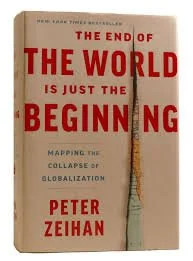
I’ve been spending time reading and watching a geopolitical strategist named Peter Zeihan. He is a trained economist and demographer, meaning he studies trade and population trends with a healthy dose of military strategy thrown in. He has a few claims that reinforce the points I made in Part I about how young people should think about the future
Noe there is absolutely nothing spiritual about his approach. This blog post will contain absolutely no spiritual wisdom, unless you think that understanding the context of your survival dance, the way you meet your material needs, counts as spiritual.
Zeihan begins with the idea that the era of globalization that started after WW II has been fabulously successful AND is in the process of ending. Let’s tease that apart.
Globalization has made possible the utter profligacy of material goods that overflow our lives. I think we truly have no idea how much of what we take for granted has only been possible because of the incredibly complex array of global trade. Take this run of the mill computer I am typing this on. The components of this computer involve thousands of steps in dozens of countries. Here’s another example. I’m moving into a new place that has less closet space, so I’m acutely aware of how many clothes I own. The average person in the 1700’s had 2-3 everyday outfits plus one fancier outfit, the proverbial Sunday best. I have 8 turtlenecks, 7 flannel shirts, 12 pairs of wool socks, some untold number of cotton socks—you get the picture. I’m completely not a shopper and still look at all this stuff I have.
Further, there’s been a radical improvement in quality. I’m old enough to remember cars in the 1960’s before globalization kicked in. The reason that Japanese cars got a strong foothold back in the 70’s in the United States was because American cars simply sucked. FORD stood for Fix or Repair Daily.
I think globalization has a ton of both practical and spiritual problems. But its short term material success cannot be gainsaid. So why would it be going away?
Zeihan argues compellingly that the underlying foundation of what makes globalization possible is the global safety of shipping. The United States after WW II basically said to everyone that the US would guarantee the safety of shipping by sea in exchange for some level of cooperation with the world order that America was creating. Shipping by sea is incredibly important in globalization because it is cheap. Every other way of moving goods is much, much more expensive. Shipping by sea allows for things to be made wherever they are cheapest to make, allows for specialization and allows for population to grow in places that were previously constrained by lack of food or other resources.
But someone has to foot the bill for patrolling the world’s oceans, and that someone has been the US taxpayer. And the American taxpayer is getting tired of footing the bill. Why? This is my speculation not Zeihan. He just observes the fact. I think a core reason is that Americans don’t trust the system anymore because they don’t believe their kids will be better off economically than they were. There’s the yawning class abyss that has opened up in the past 50 years; the US used to be a much, much more egalitarian society with lots of room for upward economic mobility. That is far less true than it used to be. People are resentful when they can’t promise their kids that they will have a more materially prosperous lifestyle than they have. That resentment is easily turned against the other. Our politics are dominated by resentment. And with globalization, the other is everyone, not just the tribe a couple of days’ horse ride away.
The second major factor Zeihan identifies that will radically accelerate the decline in the global economy is the population bombs in major countries. Put bluntly, populations are getting older because urbanization means far fewer kids are born. (I know the image is from Al Jazerra, but it’s the best visualization I saw of it)
Lower population sounds great for those of us raised on Paul Ehrlich and the idea that the world is overpopulated. But economically there are two significant problems with lower populations.
One is that countries are simply going to run out of workers. We need workers to support all of us old folk. In societies that don’t allow for immigration, like Japan, there just aren’t enough workers to maintain industries.
The second complication relates to consumption. Consumption is good for economic growth, whatever we might think of it morally. The older a population skews, the less it consumes. The drivers of consumption in a given population are adults who have families and young adults. Consumption generally declines with fewer kids and when adults age out of child rearing years. This combination of factors means that places that don’t have enough workers or consumers are really going to be under a ton of stress. This means that places like Japan, most of Europe and maybe China are simply not going to be financially feasible at some not too distant point in the future. How soon? That’s unclear. Ironically, the US has not been under this pressure until the very recent past because of…immigration of young people—the exact thing being demonized in our current political environment.
The result, in Zeihan’s model, will be a lot of pain and a less globally connected world. This will result in all kinds of disruption, ranging from luxury items to the basic necessities of power and most seriously of all--food. China can’t feed itself. Right now that just means it imports food—but if food can’t be shipped in because of deglobalization, that is going to be a huge problem. Plus its population is too old to go back to the hard physical work of farming. Same for most Asian countries. Japan had 30 million people in 1700, and that was after significant population growth in the early Edo period. Later in the 1700’s, even with a young population, they had trouble feeding themselves and suffered periodic famines. Today the population is about 120 million.
Now we don’t live in Japan, and America is uniquely well suited when it comes to food, so we shouldn’t experience famines unless climate change hits super hard. I offer these comments about Asia just to show how bad this could get. Will it get that bad? Who knows. It will be worse in some places than others, that’s for sure.
If I were a young person, (and I’m not) I’d be asking myself how do I and my community thrive in a radically different world where the things I am used to relying on being available aren’t necessarily going to be there? And I’d come back to cultivating the skills I mentioned in the first of these occasional thought pieces.
Homestead skills,
Making a living doing locally oriented things,
Getting as healthy as possible and
Getting skilled at group process.
Why group process? Because surviving and thriving isn’t going to be about having a bunker you defend against marauding herds, it’s going to be about groups learning to work together for everyone’s benefit—a most unAmerican thing.
Climate change and its implications at some point in the future.
What do you think?